One Token, Zero Gaps: Why Physical and Digital Access Control Belong Together
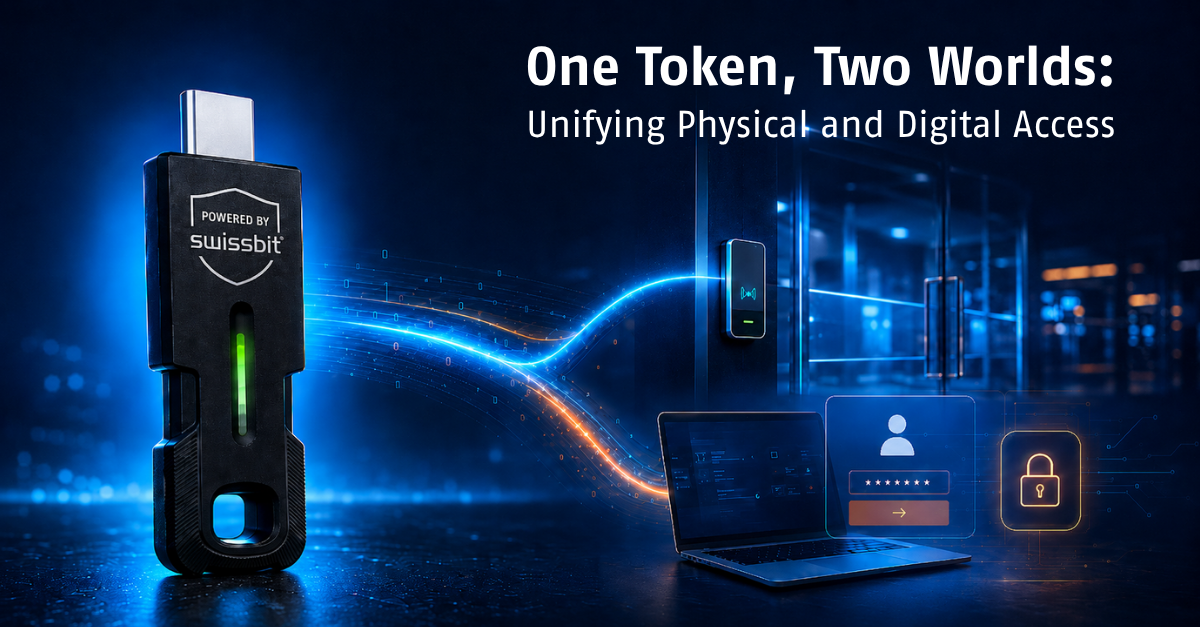

Physical and digital access control are often managed separately, even though both protect the same people, identities and resources. A multi-application hardware security key can combine phishing-resistant FIDO2 authentication with secure building-access credentials. The result is a practical starting point for reducing identity silos, improving security visibility and extending Zero Trust beyond the login screen.
Modern enterprises are connected across cloud services, workstations, smartphones, printers, industrial systems and physical locations. Every access decision introduces a potential security exposure. Yet many organizations continue to treat cybersecurity and building security as separate disciplines, with different credentials, processes and monitoring systems.
Strong authentication should not stop at the office door. The same employee who signs in to a business-critical application also enters a building, walks into restricted areas and uses shared infrastructure. Both forms of access are part of an organization’s identity-security strategy.
What Is Converged Physical and Digital Access Control?
Converged access control brings physical access control systems (PACS) and logical access control systems (LACS) into a coordinated identity-security approach. PACS governs entry to buildings, rooms and secure areas. LACS controls access to workstations, applications, networks and digital resources. Convergence aligns their credentials, policies, lifecycle processes and security signals instead of treating them as unrelated activities.
Importantly, a combined hardware token does not automatically provide a single identity platform or a correlated audit trail. Those outcomes require integration between access-control, identity-management and security-monitoring systems. The hardware brings the use cases together; the architecture and operating processes connect the decisions.
Why Physical Security Belongs in a Zero Trust Strategy
Cyberattacks do not always begin remotely. An attacker with physical access might connect an unauthorized device, tamper with equipment, remove confidential documents, misuse an unattended workstation or exploit a stolen badge. Conversely, compromised digital identities can expose sensitive information about facilities, personnel and access privileges.
A disconnected security view makes these combinations harder to detect. Imagine a door-access event in London and a privileged application sign-in in New Jersey occurring within a short period. Each event might appear routine in isolation. If the events can be reliably linked to the same identity, they may warrant investigation as a potential anomaly. Such correlation requires shared identity mappings, appropriate logging, operational integration and privacy safeguards.
This is why Zero Trust principles are relevant to physical environments: access should be granted according to verified identity, authorization, context and risk rather than assumed simply because someone holds a badge or is already inside a facility.
One Employee, Many Credentials—and Many Attack Surfaces
An employee may use different identities and authentication mechanisms for cloud applications, VPNs, operating systems, privileged accounts, printers and legacy systems. The number of credentials creates administrative work and can increase exposure to phishing, social engineering, credential stuffing and account takeover.
Hardware-backed FIDO2 authentication addresses an important part of this problem. It uses public-key cryptography and origin-bound authentication to resist phishing attacks against digital sign-in. In suitable deployments, the same physical device can also carry credentials for compatible building-access systems. This does not eliminate all cyber or physical threats, but it can reduce the number of separate items that users and administrators must handle.
RFID Security: Why a Static UID Is Not Enough
RFID and NFC credentials are widely used for physical access, but not all configurations provide the same assurance. A system that grants access based only on a readable, static unique identifier (UID) does not cryptographically verify the credential. Depending on the implementation and technology, identifiers can be copied or emulated, leaving the system vulnerable to unauthorized use.
Cryptographically protected access technologies—including MIFARE DESFire EV3 and implementations based on HID Seos or LEGIC—can offer stronger assurance through secure key storage, mutual authentication and protected exchanges with compatible readers. The security outcome depends on correct credential personalization, reader configuration, key management and lifecycle controls.
One Security Key for Two Worlds: The Swissbit iShield Key 2
The Swissbit iShield Key 2 combines phishing-resistant FIDO2 authentication with physical access capabilities in selected variants. With USB-A or USB-C and NFC options, the product family supports digital sign-in and can fit into existing access-control environments. Depending on the model and provisioning, physical-access options include MIFARE DESFire EV3, HID Seos and LEGIC technologies.
For organizations, this opens up use cases beyond the front door: secure printing, time and attendance, access to restricted areas and other supported workplace services. Digital features such as FIDO2, and additional authentication functions depending on the variant, help organizations address contemporary and legacy requirements without automatically replacing their entire infrastructure.
Combining the functions in one token is a form of credential convergence. Centralized policy management, synchronized deprovisioning and cross-domain event correlation are separate capabilities that must be implemented through supporting systems and integrations.
What Does Convergence Deliver?
| Area | Potential benefit | Dependency / qualification |
|---|---|---|
Employee experience | One familiar token for selected digital and physical workflows | Compatible services and readers |
Identity lifecycle | Coordinated onboarding, role changes and offboarding | Connected IAM/PACS processes |
Security visibility | Security visibilityPhysical and digital events can be compared | Identity mapping, logs and monitoring integration |
Operational efficiency | Fewer separate physical credentials and handling processes | Deployment scope and local requirements |
Authentication strength | Phishing-resistant FIDO2 sign-in plus cryptographic physical credentials | Correct configuration of both functions |
There are practical trade-offs. A lost combined token may affect both workplace entry and digital login. Organizations therefore need clear reporting, backup authentication, emergency access, rapid revocation and replacement procedures. A consolidated device reduces credential fragmentation only when these safeguards are built into the operating model.
Expert View: Convergence Starts with Identity

Attackers do not distinguish between a compromised login and an unlocked door. They look for the easiest route to an identity, a system or a sensitive area. Bringing physical and digital access closer together gives organizations a better chance to apply consistent policies, reduce blind spots and make strong authentication part of everyday work.
Six Steps to Converged Access Control
Map the environment. Identify PACS, LACS, identity providers, door readers, credentials, devices and the teams responsible for them.
Prioritize the use cases. Start with privileged users, restricted locations, shared workstations or secure printing where the value is measurable.
Validate credential compatibility. Check supported reader technologies, token variants, provisioning and any restrictions of existing infrastructures.
Align the identity lifecycle. Define joining, role changes, temporary access, loss, revocation, recovery and offboarding across both domains.
Connect security telemetry where appropriate. Evaluate identity correlation, logging, monitoring, privacy requirements and incident-response workflows.
Pilot before scaling. Test user experience, fallback access, device replacement, service-desk procedures and responsibilities with a representative group.
Conclusion: One Identity, One Token, Fewer Gaps
Organizations do not need another disconnected credential. They need a more coherent approach to granting and managing access, whether at an application login or a physical entrance. Converging physical and digital access is ultimately an identity, policy and governance initiative—not merely a hardware rollout.
The Swissbit iShield Key 2 provides a practical hardware foundation by bringing phishing-resistant digital authentication and supported physical-access credentials into one device. Combined with compatible infrastructure and coordinated processes, it can help organizations simplify daily workflows and strengthen their overall access-security posture.
Explore the Swissbit iShield Key 2 and discuss how its digital and physical access capabilities could fit your organization’s existing infrastructure.
Frequently Asked Questions: Physical and Digital Access Control
It is an approach that coordinates physical access control systems (PACS) and logical access control systems (LACS) through common identity policies, credential lifecycle processes and, where integrated, security monitoring. The systems do not have to be replaced by a single platform.
Yes, if the security key supports both functions and the relevant systems are compatible. Selected Swissbit iShield Key 2 variants combine FIDO2 authentication with supported physical-access technologies such as MIFARE DESFire EV3, HID Seos or LEGIC.
No. One token can carry both credentials, but coordinated provisioning, revocation, centralized policies and cross-domain event correlation require additional processes and compatible management integrations.
FIDO2 uses origin-bound public-key authentication, helping prevent phishing-based theft or relaying of sign-in credentials. The private authentication key remains protected by the authenticator; a legitimate-domain check is central to its phishing resistance.
A static UID is an identifier rather than cryptographic proof of authenticity. Systems that rely on it alone may be vulnerable to copying or emulation. Cryptographic credentials and appropriately configured readers provide stronger assurance.
Potential benefits include fewer separate credentials, simpler employee workflows, more coordinated onboarding and offboarding, and better investigation context when access events are reliably correlated. The results depend on system integration and governance.
The organization should have procedures to suspend or revoke both the digital and physical credentials, issue a replacement and provide secure fallback access. The two functions may need to be revoked in different back-end systems.
Test reader and application compatibility, digital enrollment, physical credential provisioning, identity mapping, access revocation, recovery, replacement, emergency access, monitoring and user experience with a representative pilot group.
Convince yourself of our expertise