e.MMC, UFS or PCIe BGA? Choosing the Right Soldered Storage for Industrial Systems

A recent customer conversation brought me back to a topic I discussed in my previous article, From Wafer to e.MMC: Swissbit’s Answer to a Turbulent Storage Market.
The customer was considering moving from eMMC to UFS. But the reason was not performance: the existing eMMC solution already met the application’s requirements. Instead, the discussion was driven by concern about future availability, as several semiconductor manufacturers are reducing their commitment to eMMC.
The concern is understandable, but changing the interface does not eliminate the underlying supply risk. Both eMMC and UFS depend on NAND flash. When NAND capacity is constrained and manufacturers prioritize other product categories, allocation can affect both technologies. UFS is therefore not automatically more readily available simply because some suppliers are withdrawing from eMMC. A transition motivated only by supply concerns may instead introduce new risks: host compatibility, software changes, board redesign, qualification effort and greater dependence on a limited industrial-grade UFS supplier base.
The key question is therefore not whether UFS is the general “successor” to eMMC. It is which storage technology best matches the host interface support and product requirements like performance, density, boot loader support, integration and lifecycle expectations of the application.
eMMC remains a viable industrial technology
eMMC is a mature and widely established managed-NAND SSD JEDEC standard. It offers straightforward integration, low power consumption and predictable behavior. For PLCs, HMIs, gateways, IoT devices and many embedded systems, its performance remains entirely sufficient.
Its maturity is also an advantage. The host interface is stable and broadly supported by embedded processors and operating systems. A storage manufacturer can migrate an eMMC product across newer NAND generations while maintaining a consistent interface and controlled behavior toward the host system.
Swissbit plans to continue supporting eMMC across future NAND technology cycles, including upcoming next BiCS generations, with a planning horizon extending beyond 2035+.
This does not mean keeping the same physical NAND component unchanged for more than a decade. It means managing technology transitions through controlled qualification, stable firmware, transparent change management and long-term product planning. For an existing system whose requirements are met by eMMC, there is therefore no need to change interfaces solely because individual semiconductor manufacturers are leaving the market.
The real comparison: eMMC, UFS or PCIe BGA?
For new industrial designs, the decision should not be limited to eMMC versus UFS. Where significantly higher performance is required, PCIe BGA may be the more relevant alternative.
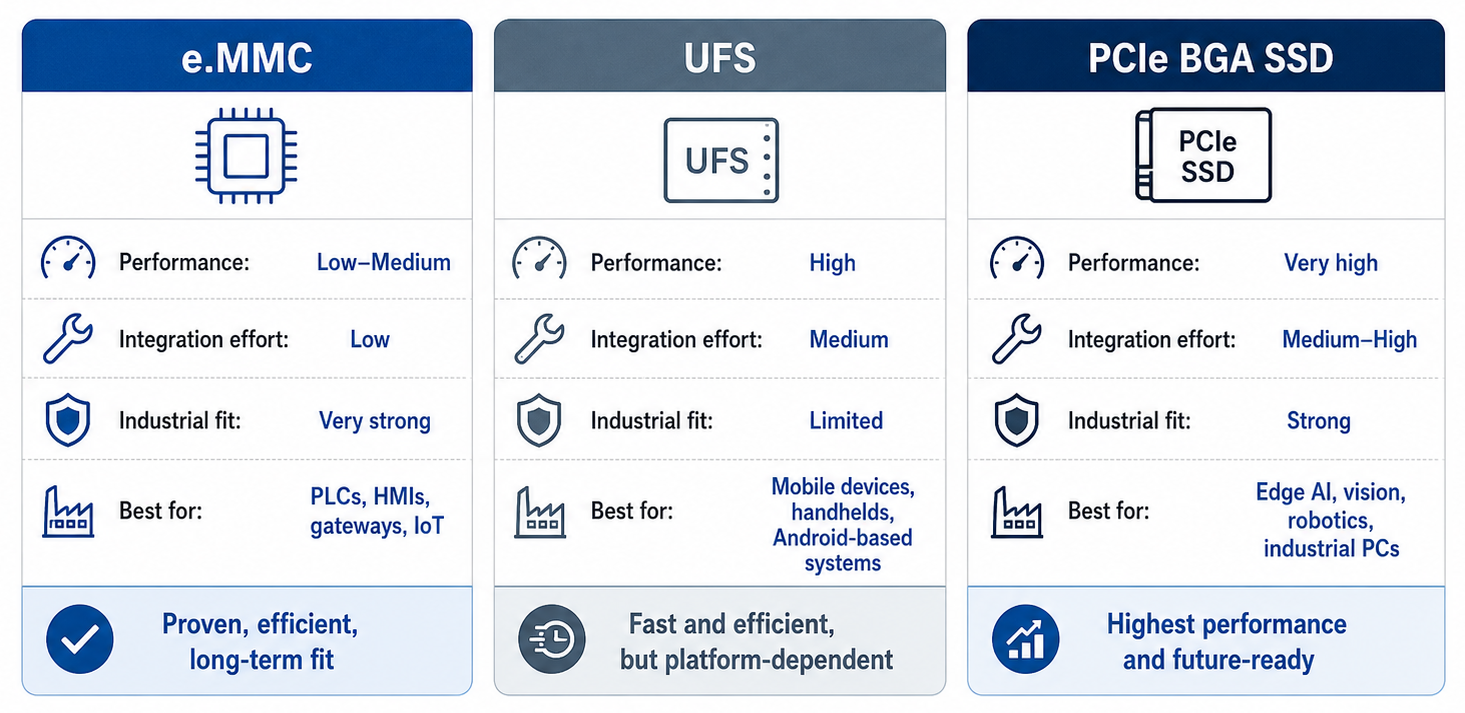
This overview is intentionally simplified. The right choice always depends on the complete system.
eMMC: proven and efficient
For applications where robustness, long-term availability, and implementation simplicity are the primary requirements, e.MMC remains a highly effective storage solution. It continues to deliver sufficient performance for many PLCs, HMIs, gateways, IoT devices, and embedded control systems.
e.MMC is natively supported by virtually all embedded processors and chipsets, enabling broad platform compatibility and straightforward boot integration. It also benefits from a mature software ecosystem spanning boot loaders, drivers, and operating systems.
Its standardized interface, predictable behavior, and lower design complexity help reduce development effort, PCB complexity, and overall system cost. For platforms whose storage requirements are fully met by e.MMC, it remains a proven, efficient, and sustainable choice for long-life industrial applications.
UFS: faster, but more platform-dependent
UFS offers significantly higher performance than e.MMC, good energy efficiency and full-duplex communication. These characteristics can be attractive for mobile industrial devices, handheld systems and selected ARM- or Android-based platforms.
However, UFS depends heavily on support from the selected SoC and its software environment. The number of suppliers offering UFS products with industrial temperature ranges, controlled firmware and long-term availability is also comparatively limited. UFS can therefore be the right choice when its performance or energy advantages provide a clear application benefit. It should not be treated as an automatic solution to eMMC supply uncertainty.
PCIe BGA: the high-performance alternative
For applications with demanding storage requirements, PCIe BGA SSDs provide considerably higher performance, larger capacities and access to modern NVMe features. They are particularly relevant for machine vision, robotics, Edge AI and industrial PCs.
PCIe is natively supported by most modern processors and chipsets. This enables broader platform compatibility, simpler integration and benefits from the mature NVMe software ecosystem like boot loader, driver and operating systems.
Although PCIe requires more design effort, it offers a broadly supported and flexible migration path for performance-oriented platforms. Power consumption should be evaluated at system level rather than treated as a fixed disadvantage. Reduced lane counts, lower link speeds and power-saving modes can help balance performance and energy requirements.

The right storage technology is not necessarily the newest one. It is the one that remains reliable, supportable and appropriate for the system.
Industrial suitability is more than performance
In industrial applications, maximum transfer rates are only one part of the decision. Availability over seven, ten or more years, operating temperature, firmware stability, endurance, power-loss behavior and controlled NAND transitions are often more important than headline benchmark results.
An interface alone does not make a product industrial. Industrial suitability depends on the complete implementation: NAND selection, controller design, firmware, qualification, manufacturing, traceability and lifecycle management.
Migrate for a requirement, not out of fear
The reduction of e.MMC portfolios by some semiconductor manufacturers is creating understandable uncertainty. But it does not make e.MMC technically obsolete, and moving to UFS does not automatically improve supply security. For systems whose requirements are already met by e.MMC, continued support from an industrial storage specialist can avoid unnecessary and costly redesign.
For applications that genuinely require more performance, UFS and PCIe BGA should both be evaluated. In many demanding industrial systems, the PCIe NVMe SSD as BGA may offer the broader and more flexible long-term path.
Swissbit continuously evaluates emerging storage technologies such as UFS in terms of performance, ecosystem maturity, and long-term suitability for industrial applications. Our focus remains on delivering reliable storage solutions that provide clear customer value, supported by Swissbit’s expertise in firmware, manufacturing, and lifecycle management.
The best storage technology is not necessarily the newest one. It is the one that can reliably meet the application’s requirements throughout the complete lifecycle of the system.
Convince yourself of our expertise

Alexander Lenz serves as Senior Product Manager for Memory Solutions at Swissbit. With more than 10 years of experience in product management, and more than 5 years at Swissbit, he is responsible for the definition, development, marketing, and lifecycle management of highly reliable memory products with a focus on e.MMC solutions.