From Wafer to e.MMC: Swissbit’s Answer to a Turbulent Storage Market
The storage market is currently anything but calm. If you speak with buyers, procurement teams, or system designers, the same keywords come up again and again: allocation, price increases, last-time-buy notifications. What used to be a relatively predictable component category has become a strategic risk factor.
One development is particularly striking: major semiconductor manufacturers are steadily discontinuing their e.MMC portfolios. For many customers, this comes as a surprise – often at a very late stage in a product lifecycle. And it raises an obvious question: Who will still be there for e.MMCs in the years to come? At Swissbit, the answer is clear. We are.
A shrinking market – and a growing blind spot
In conversations with customers, I often notice a fundamental misunderstanding about the current e.MMC landscape. Many assume that all e.MMCs essentially come from the same sources and that suppliers mainly differ in branding or logistics. In reality, the gap between providers has never been wider.
As more semiconductor vendors exit the e.MMC market, the number of suppliers with truly internal design, development, and manufacturing capabilities is shrinking rapidly. At the same time, many market participants are offering relabeled ODM products – solutions developed and manufactured elsewhere, with limited influence over silicon, firmware, test methodology or change management.
This is where Swissbit’s position stands out.
In-house, end-to-end – and not just on paper
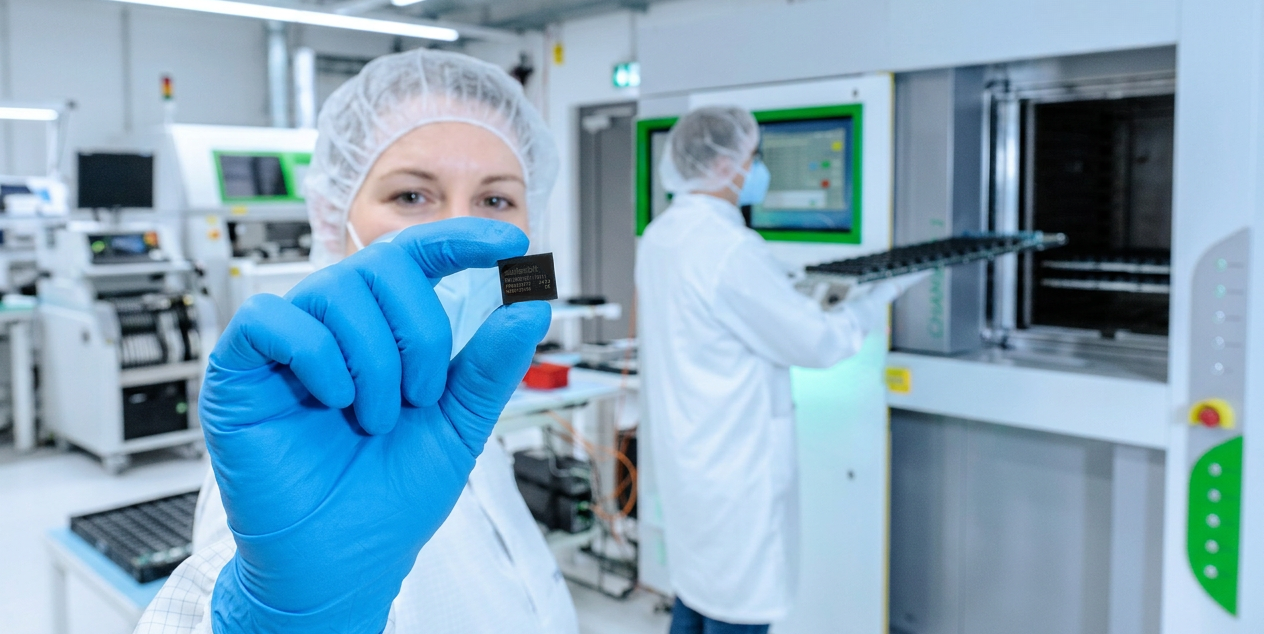
One of the most surprising moments in customer discussions is often when I mention that Swissbit manufactures its e.MMCs entirely in-house, in Berlin, starting at wafer level. This is not a marketing phrase; it’s a technical and organizational reality.
Swissbit does not rely on external OSATs in Taiwan for assembly and test, nor do we simply integrate third-party reference designs. Instead, we control the full value chain ourselves. That alone is already rare in today’s e.MMC market. But more importantly, it enables very tangible advantages for our customers.
Why in-house manufacturing is not just about pride
When production and testing are fully under one roof, it fundamentally changes what’s possible. From a customer perspective, three benefits stand out.
1. Quality and TCO
Full control over manufacturing and test allows Swissbit to achieve extremely low DPPM rates. This is not just a statistical achievement – it directly impacts field failure risk, qualification effort, and long-term system reliability. In many projects, this translates into a lower total cost of ownership over the product lifetime.
2. Customization at hardware and firmware level
With tight control over hardware design and firmware management, Swissbit can adapt e.MMCs to specific application requirements – from power-loss behavior and performance tuning to endurance optimization and qualification constraints.
Swissbit define, design, verifies, and maintains the firmware throughout the product lifecycle, enabling fast root-cause analysis, controlled updates, and long-term consistency in industrial and embedded applications.
3. Supply chain flexibility and operational control
In-house manufacturing gives Swissbit the flexibility to respond quickly to demand fluctuations, adjust production planning at short notice, and maintain full visibility into capacity and utilisation. Manufacturing in Berlin also adds geographic diversification outside traditional Asian manufacturing hubs, helping reduce risks from logistics disruptions, allocation bottlenecks, or geopolitical tensions.
What “Manufactured in Berlin” actually means
Without going too deep into process details, it is worth outlining what in-house manufacturing at Swissbit really involves because it is far more than final assembly.
At our highly automated production facility in Berlin, e.MMC manufacturing starts at wafer level, with both NAND flash and controller. Swissbit designs its own substrates, followed by precise chip and wire bonding. After molding and balling, samples are inspected using X-ray and AOI for systematic process control.
Testing is equally comprehensive. Every single device undergoes 100% burn-in, with repeated electrical tests across full temperature ramps – covering industrial (-40°C to +85°C) and even extended temperature ranges (-40°C to +105°C), depending on the product. As an added service, Swissbit can preload customer data directly during manufacturing, turning e.MMC sourcing into a true one-stop-shop solution.
This combination of automation, process depth, and test coverage is what enables Swissbit to remain cost-competitive while maintaining strict quality control – something that is increasingly difficult with outsourced manufacturing models.


Precision in e.MMC manufacturing: From wire bonding and BGA balling to burn-in testing, each step plays a critical role in product reliability. The images show the connection of the silicon die to the package substrate, the application of 0.25-millimeter solder balls and the burn-in process used to verify e.MMC performance under demanding conditions.
A brief look at the e.MMC 5.1 EM-30 series in 3D TLC NAND
As a concrete example of how Swissbit’s in-house approach translates into real products, it is worth briefly looking at the EM-30 portfolio. The series is our primary e.MMC product family, complemented by the EM-36 3D pSLC mode variant for applications that require maximum endurance. Based on industrial-grade 3D NAND, these BGA devices cover capacities from 4 GB to 256 GB and are designed for embedded systems that need compact, vibration-resistant storage over long lifecycles.
The EM-30 series is built for robustness, reliability, and data integrity under demanding conditions, supporting an extended temperature range from –40 °C to +105 °C. It implements key e.MMC features such as boot area partitioning, RPMB, and general-purpose partitioning. The portfolio also includes a BGA 100-ball variant beside the mainstream BGA153-ball e.MMC, offering an alternative package option for designs where PCB layout, assembly and environmental robustness, or migration requirements make this format particularly attractive.
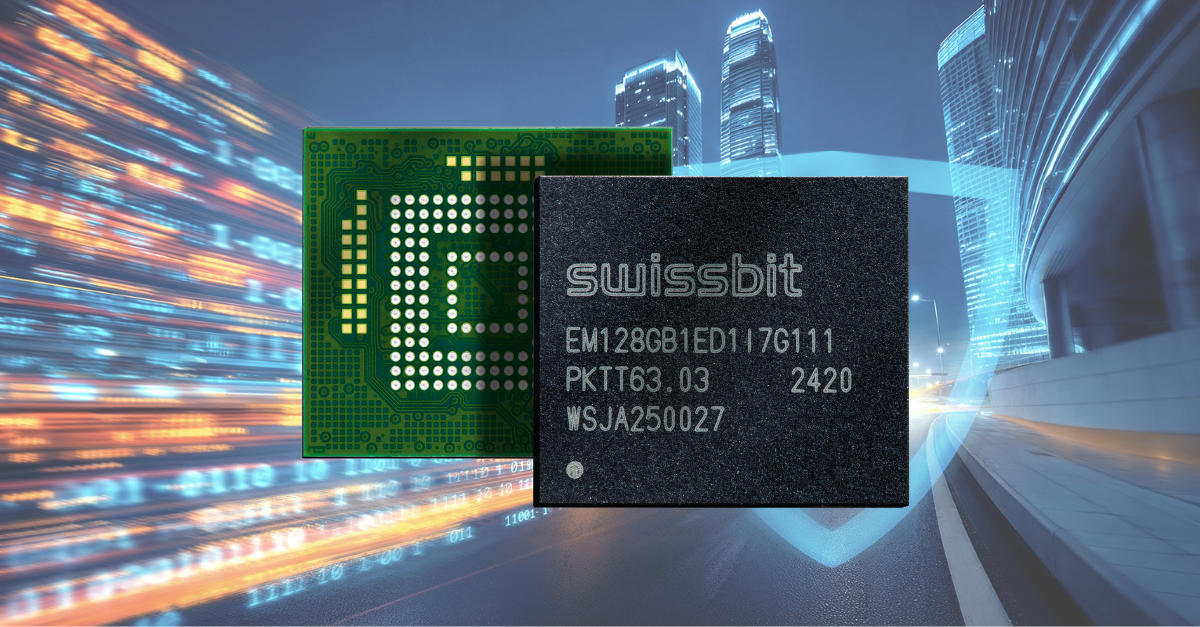
Compact, reliable storage built for demanding applications: Swissbit e.MMC products combine NAND flash, controller, and optimized firmware in a robust BGA package. Designed for industrial and automotive environments, they deliver dependable performance, data integrity, and long-term availability
Looking ahead: Stability as a strategic advantage
The current market dynamics will not disappear overnight. Allocation pressure, portfolio discontinuations, and rising complexity in supply chains are likely to remain part of embedded system design for years to come. In this environment, Swissbit’s approach to keep e.MMC manufacturing in-house, to invest in development expertise, and to commit to long-term product availability has become a strategic differentiator rather than a legacy choice.
I like to see this as a quiet advantage: not the loudest headline, but the one that matters when systems need to run reliably for a decade or more. For customers who depend on e.MMCs beyond the next product cycle, that difference is becoming increasingly visible.
Our experts are happy to help.

Alexander Lenz serves as Senior Product Manager for Memory Solutions at Swissbit. With more than 10 years of experience in product management, and more than 5 years at Swissbit, he is responsible for the definition, development, marketing, and lifecycle management of highly reliable memory products with a focus on e.MMC solutions.