Security Key Management for Enterprises: Managing iShield Key 2 with Appterix
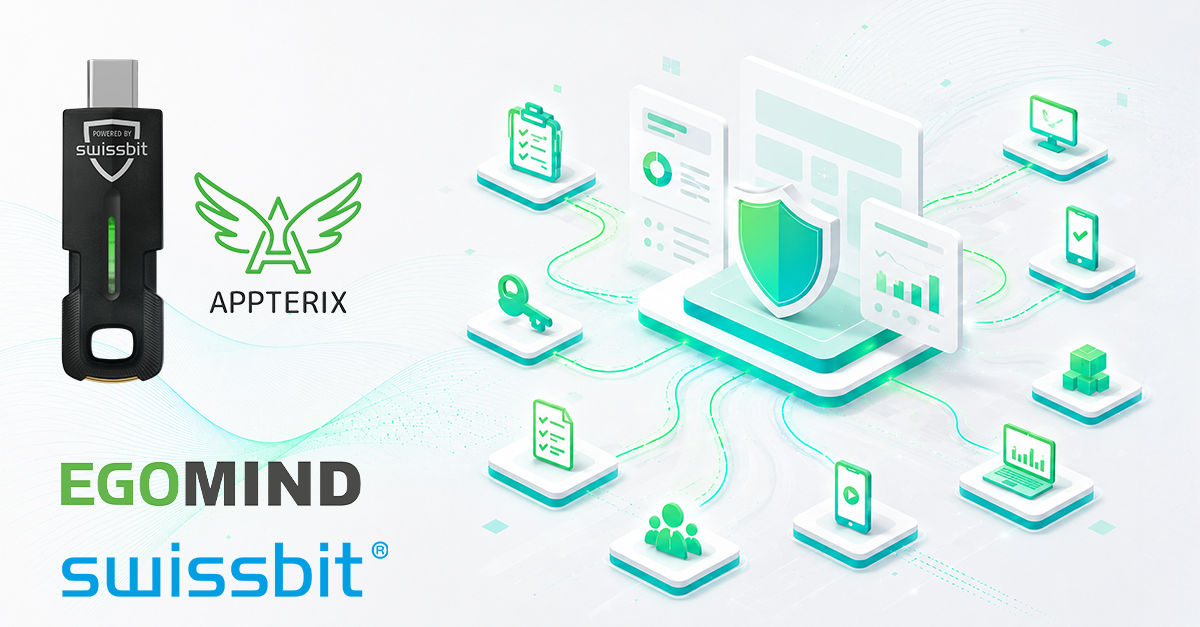
How Swissbit and EgoMind simplify FIDO2 security key management
Phishing-resistant multi-factor authentication is an important building block of modern Zero Trust strategies. But once an organization has not ten, but several thousand hardware security keys in use, a new challenge emerges: How does IT keep track of inventory, distribution, usage, and key status?
This is exactly where our collaboration with EgoMind comes in. The Appterix management solution now also supports the Swissbit iShield Key 2, adding a centralized management layer for the rollout and day-to-day operation of our secure authentication hardware.
For our customers, this means they can scale their iShield Key deployment without having to scale the administrative effort at the same pace.
Live Webinar by Egomind & Swissbit
Hardware MFA on Autopilot: Centralized Management of Swissbit iShield Keys with Appterix
Date: November 3, 2026
Time: 10:00–11:00 AM CET

From 1,000 keys to a controlled rollout
A real-world use case illustrates why security key management quickly becomes relevant.
A company with several thousand users decides to roll out iShield Keys across the organization. As a first step, it purchases 1,000 keys and starts distributing them to employees immediately.
It does not take long before some very practical questions arise:
How many keys have already been issued? How many are still in stock? Which employee has which key? And are the issued keys actually being used?
With Appterix, this information is available centrally. Inventory and issuance are tracked automatically, while the assignment of iShield Keys to users can be handled manually or automatically. At the same time, IT can see which issued keys are actively being used.
Instead of maintaining separate lists and manual processes, IT gains an up-to-date view of its security key inventory.
Beyond inventory: managing the full lifecycle
For us, one point is crucial: a FIDO2 rollout does not end when a key is handed over to an employee.
Security keys need to remain manageable throughout their entire lifecycle. This is where the combination of iShield Key and Appterix adds further capabilities.
Keep certificates under control:
In relevant use cases, Appterix monitors the status of certificates used on the keys. Expired certificates or certificates approaching their expiration date become visible, allowing IT to act before they cause operational issues.
Allow only authorized keys:
Purchased iShield Keys can be designated as Corporate Devices. Unauthorized security keys can be blocked, helping organizations ensure that only approved authentication devices are used.
Target hardware refreshes:
When an organization later moves to a newer model, Appterix shows which users are still using an older iShield Key. This allows IT to manage the replacement in a targeted way rather than replacing devices indiscriminately.
What happens if an iShield Key is lost?
Losing a security key is one of those situations for which organizations need a clearly defined process.
With Appterix, an iShield Key 2 can be marked as lost by either the user or an administrator. If the key is later connected to a system again, the administrator receives a notification. At the same time, the lost key can be blocked manually or automatically.
This turns a potential security and support issue into a controlled process.

With Appterix, we are creating a platform that gives companies the freedom to manage security keys flexibly across different manufacturers. Through our partnership with Swissbit and the integration of the iShield Key 2, manufactured in Germany, we are expanding our ecosystem with another powerful, highly secure option. This creates a particularly compelling combination for organizations that, in addition to modern authentication, also rely on MIFARE-based physical access control.
Appterix takes a vendor-agnostic approach to security key management and supports other established security key vendors alongside Swissbit. The iShield Key is manufactured at Swissbit's own semiconductor production facility in Berlin. Swissbit combines this with a transparent European supply chain and traceability of the components used.
Strong authentication needs strong management
The iShield Key 2 provides organizations with a hardware-based foundation for modern, phishing-resistant authentication. With EgoMind, our customers now also have a strong partner for the next challenge: the efficient rollout and management of large security key fleets.
Appterix provides transparency into inventory, user assignment, and usage, while supporting important lifecycle processes such as certificate management, hardware refreshes, and lost-key scenarios.
For me, this is the key value of the collaboration: organizations do not have to choose between strong hardware security and efficient operations. The two can go hand in hand.
FAQ: Managing iShield Key 2 with Appterix
Yes. Appterix lists Swissbit as a supported vendor for security key management. It enables centralized management of the keys and, depending on the use case, associated certificates throughout their lifecycle.
Yes. Appterix supports both manual and automated assignment of iShield Keys to users. This allows IT to see which keys have already been assigned and which are still waiting for assignment.
Yes. A key can be marked as lost and then blocked manually or automatically. If a key marked as lost is connected again, the administrator can be notified.
Yes. The inventory and distribution of iShield Keys can be tracked continuously. This makes it possible to see, among other things, how many keys have already been issued and how many are still in stock.
Yes. Appterix can track the usage of issued iShield Keys, providing visibility into which devices are actively in use.
Yes. Older models that are still in use can be identified, allowing a migration to a newer generation of devices to be managed in a targeted way.

Hendrik serves as Sales Director Security Solutions at Swissbit, where he is responsible for the global sales strategy for the company’s authentication and data protection portfolio. Bringing nearly 20 years of experience in the IT security industry, he has deep expertise in international sales, strategic partnerships, and the development of high-performing teams. Prior to joining Swissbit, he held a number of senior leadership roles at G DATA CyberDefense AG, most recently serving as Vice President Global Sales & Marketing. Follow him on LinkedIn.