Passwordless Authentication for Corporate & Government Security
FIDO security keys and certificate-based authentication to protect your organization from phishing, credential theft, and unauthorized access
Credential theft as the dominant attack vector
Credential theft has become the primary attack vector targeting organizations and government institutions. Password-based authentication leaves systems vulnerable to social engineering, and account takeover, risks that persist regardless of password complexity or rotation policies.
Impact of unauthorized access on critical sectors
When unauthorized users gain access to privileged systems, the consequences extend far beyond data breaches. Critical infrastructure operators face service disruptions, financial institutions risk regulatory penalties, government agencies confront compromised operational security, and defense contractors deal with intellectual property theft.
Why software-based MFA falls short
Traditional software-based multi-factor authentication provides limited protection. SMS codes can be intercepted, software tokens compromised, and mobile authenticator apps depend on device security you cannot control. Swissbit hardware security keys eliminate these weaknesses through passwordless and certificate-based authentication. Our FIDO-certified devices deliver phishing-resistant security, manufactured within a secure European supply chain.
Security Requirements Driving Hardware Authentication Adoption
Regulatory Requirements for Authentication Security
NIS2 / KRITIS-V (Critical infrastructure & essential services)
NIS2 strengthens cybersecurity requirements for operators of essential and important services, including mandatory risk management measures and stronger access controls. Phishing-resistant multi-factor authentication is a key requirement. FIDO-certified hardware security keys provide robust identity protection, reduce credential-based attacks, and support audit and accountability requirements.
DORA (Digital Operational Resilience Act)
DORA focuses on protecting financial institutions against ICT-related risks. It requires strong authentication, secure access to critical systems, and resilience against advanced cyber threats. Hardware security keys protect credentials in tamper-resistant hardware and strengthen identity assurance across IT environments.
Cyber Resilience Act (CRA)
The EU Cyber Resilience Act introduces mandatory security requirements for products with digital elements throughout their lifecycle. Swissbit hardware security solutions support CRA alignment through certified secure hardware design, tamper-resistant components, and security upgrade options without full product redesign.
OMB M-22-09 (US Federal Zero Trust)
OMB M-22-09 defines the US federal Zero Trust strategy and requires agencies to deploy phishing-resistant MFA for system access. Hardware security keys enable passwordless, phishing-resistant authentication aligned with Zero Trust principles and federal security guidance.
Swissbit Products



Corporate security can no longer rely on passwords as the primary line of defense. FIDO Security Keys as hardware-backed, phishing-resistant authentication devices gives organizations the strongest foundation for protecting identities and critical applications.
Real World Use Cases for Hardware Authentication
Why Swissbit for Hardware Security
Swissbit delivers hardware-based authentication designed for long lifecycles, high security demands, and regulatory requirements.
When authentication hardware protects your most sensitive systems, supply chain security matters as much as cryptographic strength. Swissbit hardware security keys are developed and manufactured within a secure European supply chain with full transparency and component traceability.
For more than a decade, Swissbit has applied its engineering expertise to hardware-based security and authentication solutions for enterprise and regulated environments. Building on deep roots in industrial hardware design, Swissbit develops authentication products that combine cryptography, secure elements, and robust form factors.
ISO9001 (Quality Management), IEC60068 (Industrial Temperature Testing), ISO27001 (Information Security), ISO14001 (Environmental), ISO50001 (Energy), REACH, RoHS, Conflict Minerals compliant
Contact us
Get in touch with us and discuss your requirements with us.
Where to buy Swissbit products
Find the local, regional, and worldwide sales contacts.
Related Blogs

In my latest blog post, I take a close look at the global airline industry. What challenges does it face, particularly with regard to cybersecurity? What solutions are available, and how can airlines use them to improve security and resilience? Finally, I share my conclusion.
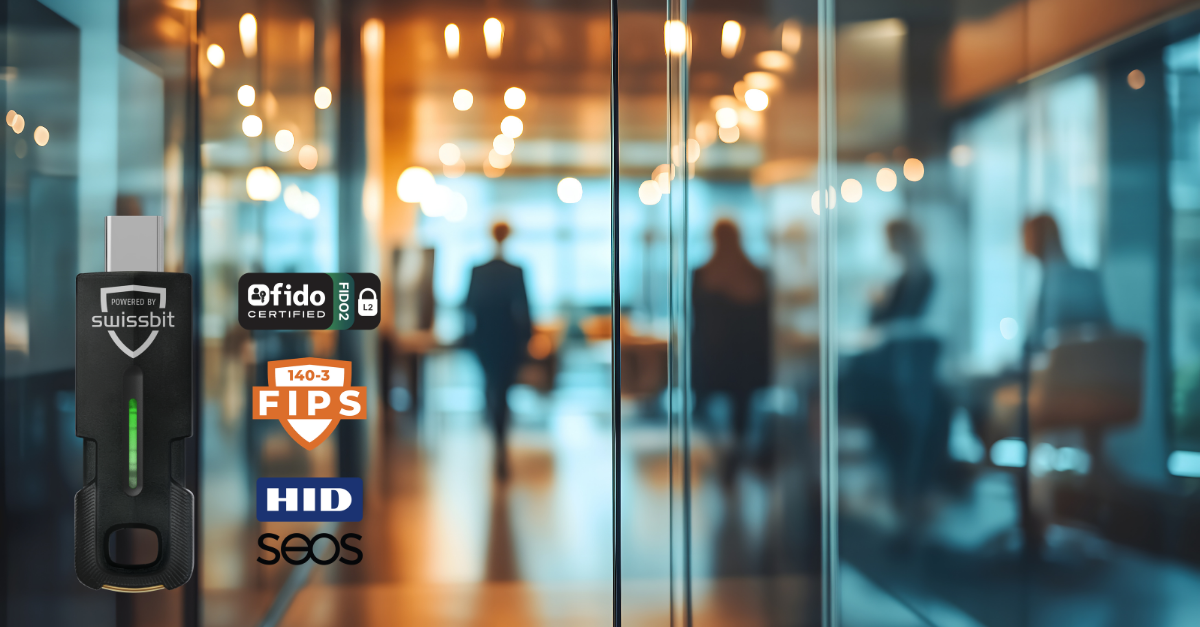
In my latest blog post, I take a closer look at government ministries and federal agencies. They operate at the heart of national resilience. They manage vast quantities of sensitive information - policy drafts, administrative records, and classified material - making the public sector one of the most attractive targets for cybercriminals.
In my latest blog post, I discuss supply chain security. In today's hyper-connected world, the integrity of supply chains is essential for digital sovereignty. As every system, line of code, and component becomes more interconnected, security can no longer be considered a secondary concern. Security must be embedded throughout the entire value chain, from design to delivery.
Frequently Asked Questions
FIDO authentication uses public-key cryptography where private keys never leave hardware security keys. When you authenticate, your hardware security key cryptographically proves it possesses the private key corresponding to your registered public key – without revealing the private key itself. This cryptographic protocol includes the service's domain name, so hardware security keys only respond to legitimate services. Even if you attempt to authenticate on a phishing site, your FIDO2 hardware security key refuses to respond because the domain doesn't match. This makes phishing attacks technically impossible, unlike passwords or software tokens that users can be tricked into providing to attackers.
Software-based authentication (SMS codes, authenticator apps, push notifications) stores secrets in software that can be extracted by malware, intercepted during transmission, or compromised through social engineering, like MFA fatigue. Hardware security keys generate and store cryptographic keys in tamper-resistant hardware chips that never expose these keys to software or networks. When authentication is needed, cryptographic operations occur inside the secure hardware element. This hardware-rooted security means that even if your computer is compromised by malware, your authentication credentials remain protected inside the hardware security key.
Certificate-based authentication uses X.509 digital certificates and public-key infrastructure (PKI) to verify user identity. Organizations use certificate-based authentication for VPN access, code signing, email encryption, and smart card authentication in enterprise environments with existing PKI infrastructure. Swissbit iShield Key 2 Pro stores X.509 certificates and private keys in hardware secure elements, providing certificate-based authentication while protecting private keys from extraction. This enables PKI authentication for legacy systems while supporting modern FIDO passwordless authentication in the same device.
FIDO hardware security keys integrate with existing authentication infrastructure through standard protocols supported by major identity providers including Microsoft Entra ID (Azure AD), Okta, Ping Identity, and other enterprise IAM platforms. For Windows environments, hardware security keys work with Windows Hello for Business. Organizations can enable FIDO authentication through administrative policies without requiring application modifications. Certificate-based authentication via PIV-compatible hardware security keys (like iShield Key 2 Pro) works with existing smart card infrastructure, requiring no changes to applications that support PIV authentication.
Organizations should issue backup hardware security keys and ensure users register both primary and backup devices with authentication systems. If a user loses their primary hardware security key, they authenticate using their backup device while IT administrators revoke the lost device from the authentication system. This process is similar to replacing physical access cards but provides stronger security because hardware security keys cannot be cloned or duplicated. Organizations should establish clear policies and processes for reporting lost devices and issuing replacements.
Modern FIDO hardware security keys like Swissbit iShield Key 2 Series work across operating systems (Windows 10/11, macOS, Linux) and browsers (Chrome, Firefox, Edge, Safari) without requiring driver installation. The FIDO protocol is supported natively in modern operating systems and browsers. For certificate-based authentication and PIV functionality, organizations may need to install smart card middleware, but this software is typically already present in enterprise Windows environments. This native support means users can authenticate across different computers without administrator rights or software installation.
FIPS 140-3 is a U.S. government security standard for cryptographic modules. Federal agencies and organizations working with the U.S. government typically require FIPS validated cryptographic hardware. Swissbit offers iShield Key FIDO FIPS and iShield Key Pro FIPS models that meet FIPS 140-3 Level 3 certification requirements. Organizations operating in regulated industries or working with government entities should verify whether FIPS validation is required for their authentication hardware. For most commercial organizations, FIDO certification provides sufficient assurance of security standards.