Cybersecurity at Airports: A Hardware-Based Solution for the Digital & Physical Access Challenge
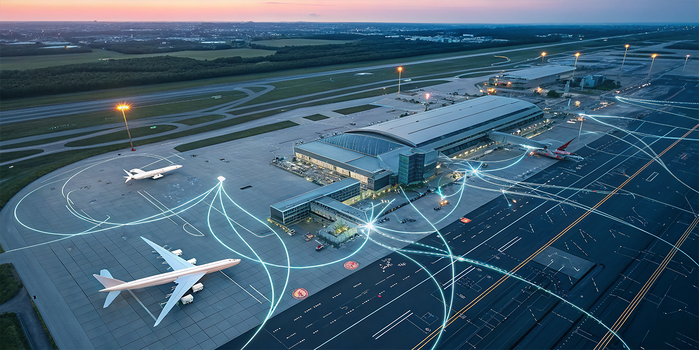
In my latest blog article, I take a closer look at the airport sector. What challenges does this sector face, especially regarding cybersecurity? What solutions are available, and what advantages do they offer? Finally, I share my conclusion.
Introduction
Airports are not just travel hubs - they are highly digitalized ecosystems processing massive volumes of sensitive data. In 2025 alone, cyberattacks on airports surged by 24% globally, underscoring their status as high-value targets and critical infrastructure components.
From flight scheduling to security access systems, digital vulnerabilities have the potential to disrupt global operations. As cyber threats escalate, the need for a secure, unified authentication solution becomes mission-critical.
According to Airways Magazine, nearly all major international airports reported vulnerabilities in at least one of these domains in 2025. These threats not only endanger passenger safety and flight continuity, but they can also trigger devastating financial and reputational consequences.
1. Three Key Challenges for the Airport Industry
The global airport industry faces three key challenges that, together, significantly impact reliability and smooth operations.
Phishing Attacks: Cyberattacks on airports are largely phishing-based and often exploit weak points in primary areas.
An attack surface that provides access to control systems and employee data: Flight scheduling and planning software, Security access control systems, Employee identity and data management, these are the core systems targeted by phishing attacks in the airport sector.
Regulatory Compliance: Like other sectors, the airport industry is affected by numerous global regulations (e.g. U.S., EU, and Germany) with which it must comply to ensure normal operations and, above all, strengthen its security and resilience.
Airports are increasingly under the control of global regulatory authorities. These authorities include:
ICAO Standards
TSA and FAA (U.S.)
EASA, NIS2 and GDPR (EU)
KRITIS (Germany)
Complying with these frameworks requires robust identity assurance systems that support secure access across both digital platforms and physical facilities.
2. The innovative Solution: iShield Key 2 from Swissbit – One key for All Access
Swissbit’s iShield Key 2 offers an all-in-one hardware-based security solution that unifies digital and physical authentication. It's tailored to meet the complex requirements of the airport sector, enabling secure access across systems while reducing complexity.
Key Features
- Dual Access in One Device Combines FIDO2 authentication for digital systems with support for MIFARE, LEGIC, and HID for physical access.
- Certified and Future-Proof Security Built-in smart card chip with FIPS 140-3 Level 3 and CC EAL6+ certification ensures top-tier data protection. The iShield Key 2 delivers also government-grade protection. These certifications ensure strong encryption, tamper resistance, and data integrity.
- Remote Update Capability All protocols can be updated remotely to maintain compliance and security readiness.
- System Compatibility Works with FIDO2, PKI, and OTP—perfect for heterogeneous IT environments.
- Rugged & Resilient in Airport environments Built for harsh airport conditions and areas where smartphones are prohibited.
3. The Benefits: Unified Authentication and Cost Savings
By combining physical and digital authentication into a single device, companies can reduce complexity and save on device management and support efforts.
Use Cases
- Securing air traffic control and surveillance systems
- Enabling secure access to employee data, buildings and equipment
- Managing third-party vendor access and data exchange
- Enforcing security in smart baggage systems and logistics platforms
Business Impact
The positive effects of integrating iShield Key 2 into airports' IT security infrastructures on their economic success are obvious and convincing.
- Reduced security incidents by eliminating password-related vulnerabilities
- Reduced operating costs due to uniform management of access devices
- Minimizing IT support costs by simplifying authentication processes
- Support for global compliance requirements and avoidance of penalties for regulatory violations
The Future: Passwordless by Default
According to the HYPR 2025 State of Passwordless Identity Assurance Report, hardware authentication devices and FIDO passkeys are expected to become the global gold standard by 2027. Swissbit’s iShield Key 2 is already delivering on that vision - today.
Conclusion
Swissbit`s iShield Key 2 is a critical enabler of secure, compliant, and efficient airport operations. As the attack surface grows and regulations become more stringent, airport providers must deploy reliable, integrated solutions that protect people, employees and data.
The iShield Key 2 series allows airports to lead this transformation and ensures they are prepared for a password-free future. With Swissbit, you gain a trusted European partner to accompany you on your digital transformation journey.
We would be happy to show you how you can build a scalable security architecture with a hardware token without compromising productivity. Convince yourself of our expertise.

Alexander Summerer has served as the Head of Authentication at Swissbit since October 2023. In his role, he's responsible for all authentication solution-related initiatives, leveraging his extensive expertise to drive innovative solutions in the ever-evolving digital landscape. Before joining Swissbit, Alexander spent over 15 years at Giesecke+Devrient, holding key positions such as Director of Product Management, Technology Consultant, and Pre-Sales expert. His expertise in ID, authentication, and IoT solutions underlines his position as a cybersecurity expert.