4-Channel vs. 8-Channel Industrial SSDs: A Comprehensive Comparison

In my latest blog post, I compare 4-channel and 8-channel SSDs. First, I outline the pros and cons. Then, I address specific issues, such as performance in edge servers. Finally, I highlight suitable products from Swissbit. Finally, I share my conclusion.
Introduction
Industrial Solid-State Drives (SSDs) are pivotal in modern computing environments, especially in edge computing and data centers. A critical aspect influencing their performance and efficiency is the number of NAND channels—commonly 4 or 8. This article delves into the distinctions between 4-channel and 8-channel industrial SSDs, examining their advantages, disadvantages, and suitability for various applications.
Understanding NAND Channels in SSDs
In SSD architecture, a "channel" refers to a data pathway between the SSD controller and the NAND flash memory. The number of channels determines how many NAND chips the controller can communicate with simultaneously. Typically, low-end SSDs feature 2 or 4 channels, while high-end SSDs boast 8 or more channels.
Advantages and Disadvantages of 4 Channel and 8 Channel SSDs
4-Channel SSDs
Advantages:
- Power Efficiency: Fewer channels result in lower power consumption, making 4-channel SSDs ideal for energy-sensitive applications.
- Cost-Effectiveness: Simpler architecture leads to reduced manufacturing costs.
- Compact Form Factor: Suitable for devices with space constraints, such as embedded systems.
Disadvantages:
- Limited Performance: Lower parallelism can restrict data throughput and IOPS (Input/Output Operations Per Second).
- Scalability Constraints: Not ideal for applications requiring high storage capacities or rapid data access.
8-Channel SSDs
Advantages:
- Enhanced Performance: Increased channels allow for higher data transfer rates (especially in sequential write applications) and better multitasking capabilities.
- Greater Capacity: Supports more NAND chips, enabling higher storage capacities
Disadvantages:
- Higher Power Consumption: More channels can lead to increased energy usage.
- Increased Cost: Complex architecture may result in higher production costs.
Performance in Edge Servers
Edge servers operate in environments where space, power, and cooling are limited. In such scenarios, 4-channel SSDs offer benefits in terms of power efficiency and thermal management. However, for applications demanding high-speed data processing, 8-channel SSDs provide the necessary performance boost.
💡 Learn more about Swissbit storage solutions for Data Centers and Enterprise Solutions.
Power Efficiency in PCIe/NVMe Storage
Power efficiency is crucial in industrial applications. Swissbit's 4-channel SSD, such as the N3000 series, are designed for low power consumption while delivering high throughput. Conversely, some 8-channel SSDs, like Swissbit's A1200, have been performance optimized. The performance of an SSD in an embedded system depends on the workload, air temperature, and airflow. At temperatures above 40°C, it is important to ensure sufficient airflow to cool the "engine" of an SSD, the NAND controller. As with an internal combustion engine, the efficiency and thermal characteristics strongly depend on the achievable performance under all environmental conditions. Key criteria include the number of NAND channels (4 vs. 8) and the architecture of the firmware and hardware.
Advantages of NVMe 4-Channel SSDs
NVMe (Non-Volatile Memory Express) enhances SSD performance by reducing latency and increasing parallelism. 4-channel NVMe SSDs benefit from:
- Lower Power Consumption: Ideal for battery-powered or energy-sensitive devices.
- Reduced Heat Generation: Simpler architecture leads to less heat, aiding in thermal management.
- Cost Savings: Fewer channels can translate to lower manufacturing and end-user costs.
Thermal Considerations
Thermal management is vital for SSD longevity and performance. 4-channel SSDs typically generate less heat due to their simpler design. However, 8-channel SSDs, with proper cooling solutions, can maintain optimal operating temperatures even under heavy workloads.
Highlight Products by Swissbit
Industrial 8 Channel SSDs like the A1200 Series provide highest sustained performance but require adequate cooling e.g airflow and/or heatsinks.
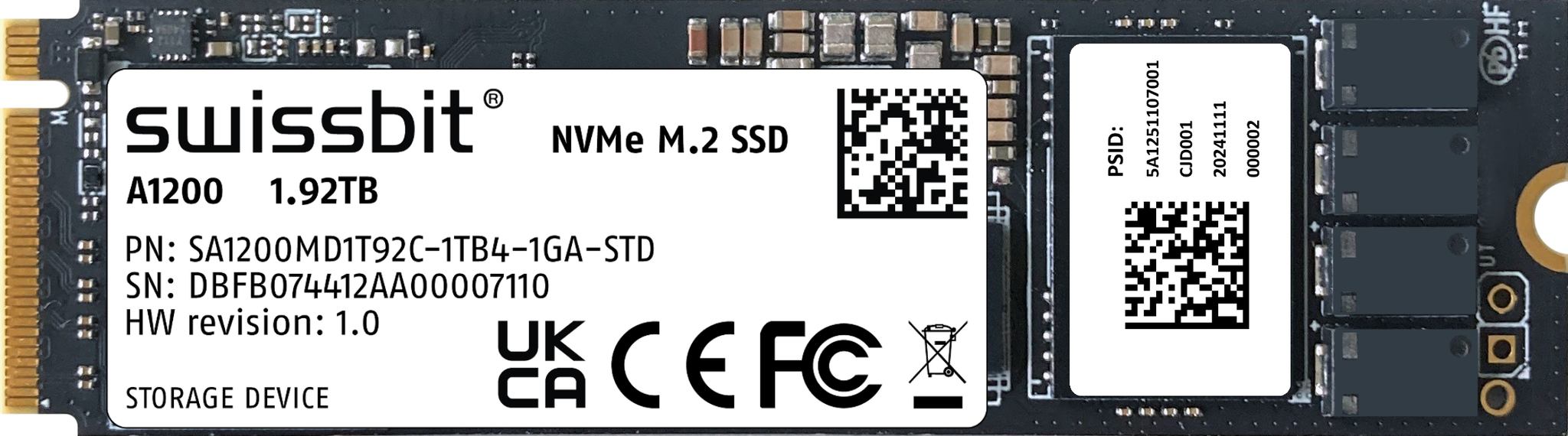
A1200 – Peak Performance
✔ M.2 form factor 2280
✔ PCIe Gen4 / NVMe 1.4 / four lanes
✔ 3D NAND eTLC up to 1.92 TB
✔ Temperature range 0°C to 70°C (A1000: -25°C to 85°C)
✔ 1 DWPD Endurance
✔ AES256 Encryption / TCG Opal 2.0
✔ Crypto erase / Secure Boot erase / Secure Boot
💡Learn more about the A1200.
Applications:
Boot drive, storage, datalogging or buffer in routers, servers, edge AI or industrial type of applications that require highest, sustained write performance and lowest latency.
💡 Learn more about Swissbit storage solutions for Data Centers and Enterprise Solutions.
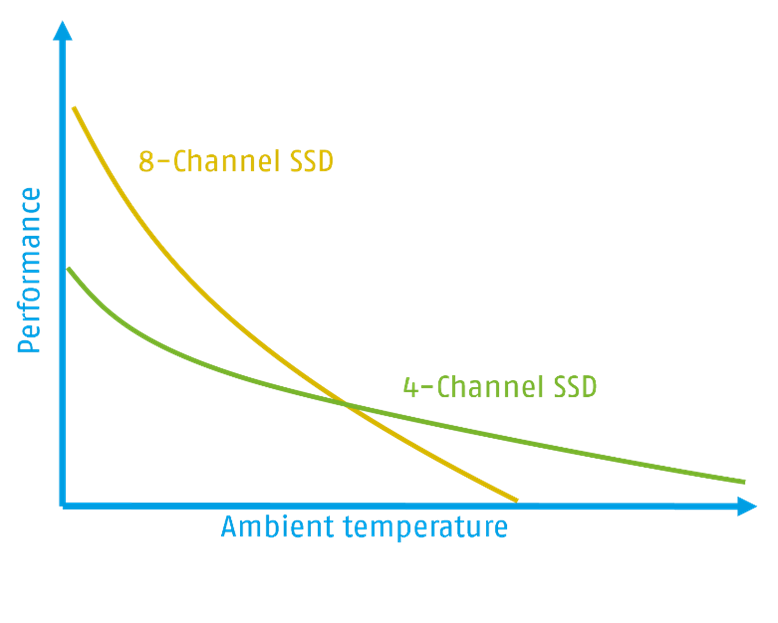
Industrial 4 Channel SSDs like the N3000 Series provide relatively modest, but very consistent sustained performance, even at very litte to no airflow.
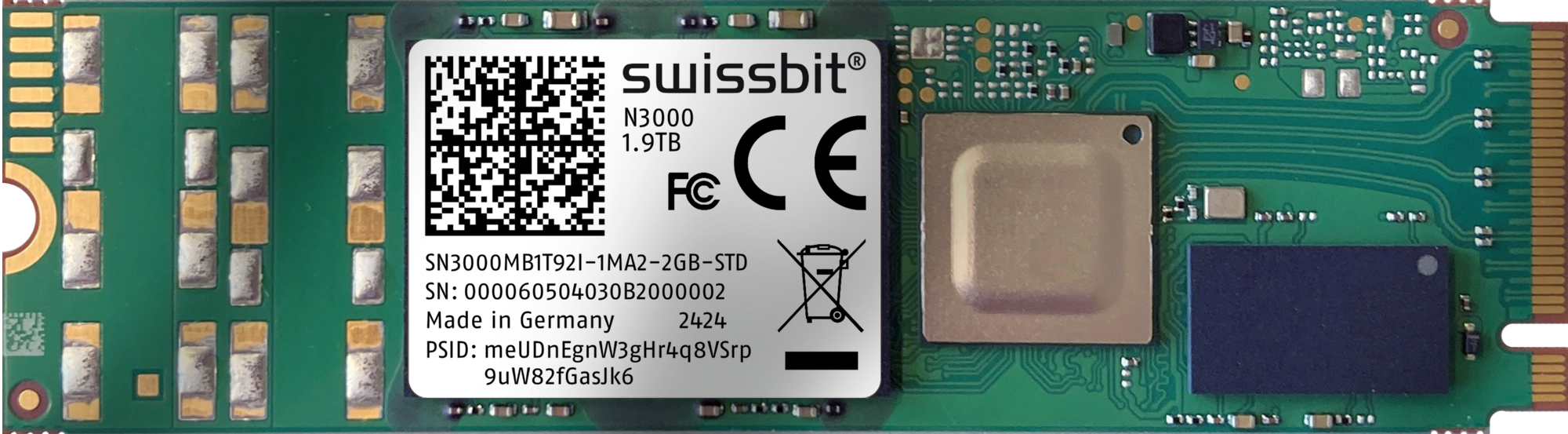
N3000 for Edge Servers and Boot Drives
A leading AMR manufacturer selected Swissbit N3000 M.2 2280 SSDs for seamless intralogistics automation. Why did they choose Swissbit N3000?
✔ Drive for OS boot purpose
✔ Reliable performance at higher temperatures
✔ Small, low power and low capacity, reliable, high retention.
✔ Secure boot, encryption, remote management, power fail protection
💡Learn more about M.2 PCIe SSD products like N3000.
Applications:
Critical, embedded systems that must provide adequate minimum performance even at very hot ambient conditions and with a limited power budget (Fanless systems, Industrial PCs, edge servers, telecom equipment, critical devices). Applications where data loss or corruption are not an option.
Conclusion
When choosing between 4-channel and 8-channel industrial SSDs depends on specific application requirements. For energy-efficient, cost-sensitive, and space-constrained environments, 4-channel SSDs are suitable. In contrast, applications demanding high performance and capacity may benefit from 8-channel SSDs. Understanding the trade-offs between these options ensures optimal system design and performance.

Norman Schmidt is Product Marketing Manager at Swissbit and an expert in industrial storage solutions. With a focus on market entry strategies, competitive analysis and the development of innovative sales strategies, he drives Swissbit's positioning in key industries such as industrial PCs and mission-critical applications.
After studying economics, he worked for five years as a product manager at GLYN, where he was responsible for industrial computers. He then briefly took on the role of Head of Product Management at Verbatim before joining Swissbit.