Why PCIe Gen4 storage for embedded systems must balance performance, power, and reliability
Introduction
In my latest blog post, I would like to take a closer look at what modern embedded systems increasingly require from storage - and why performance alone is no longer enough. As applications in industrial IoT, networking, communications, and edge AI continue to evolve, storage must do more than deliver high interface speeds. It must also support low power consumption, stable thermal behavior, and long-term reliability in real deployment conditions.
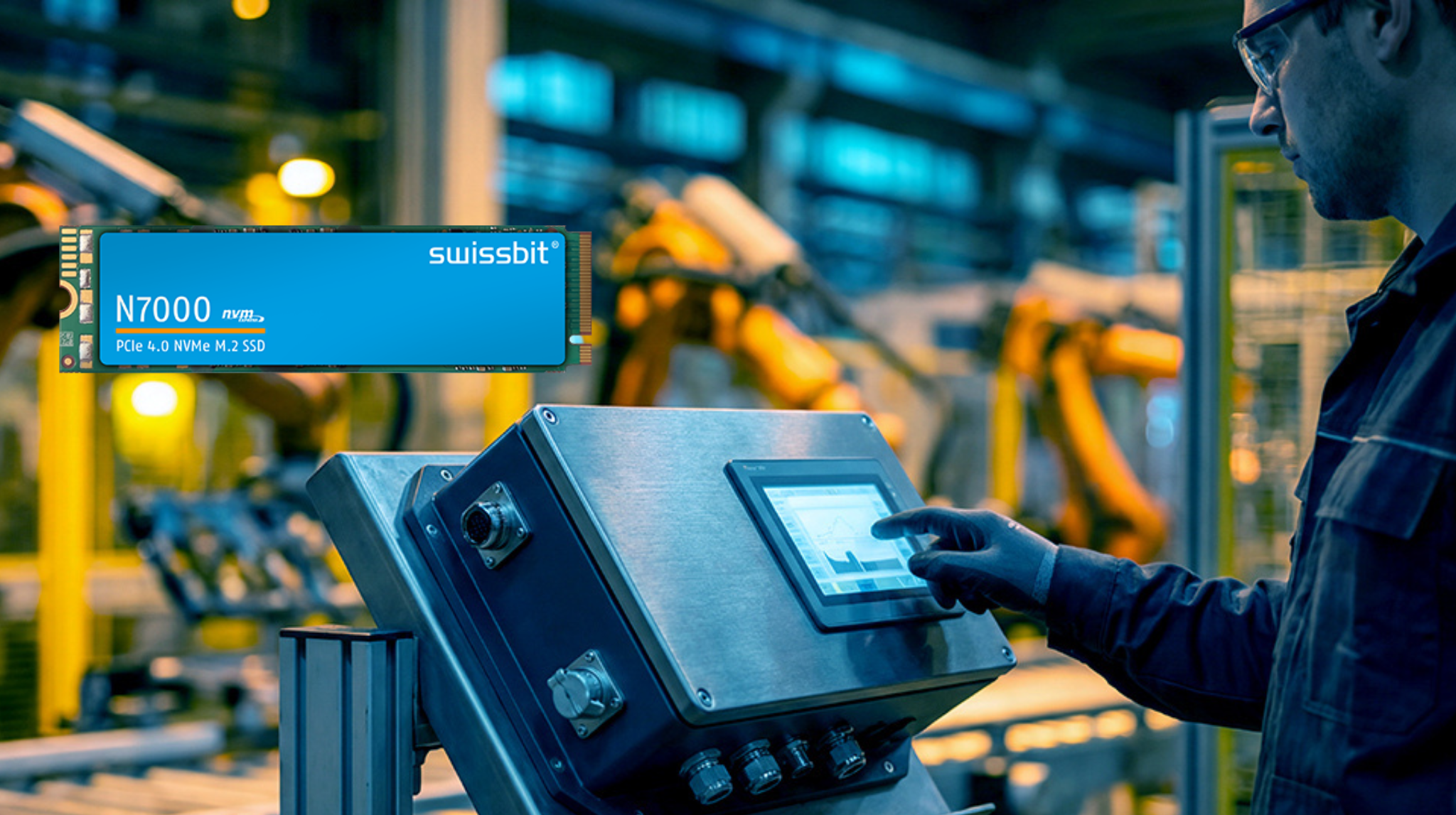
This is exactly the challenge Swissbit addresses with the new N7000 PCIe Gen4 SSD series. Designed for demanding embedded applications, the N7000 combines sustained performance, energy efficiency, and industrial-grade robustness in a versatile M.2 platform.
From peak performance to real system value
In many embedded environments, maximum benchmark numbers are no longer the most relevant metric. What matters is how reliably a storage device performs under thermal constraints, in compact designs, and often in fanless or enclosed systems.
This is particularly important in applications such as routers, switches, industrial controllers, edge servers, vision systems, and data loggers. Increasingly, it also applies to edge AI platforms, where data is processed locally and systems must respond quickly while operating within tight power and thermal limits. In these scenarios, the real value of a storage device lies in how well it maintains throughput, responsiveness, and data integrity under sustained load. That is why the N7000 series has been developed as a balanced platform for practical embedded use - delivering strong sustained performance together with low power consumption and optimized thermal behaviour.
Why PCIe Gen4 is becoming increasingly relevant
As embedded workloads become more data-intensive, the demand for higher bandwidth and faster responsiveness continues to grow. PCIe Gen4 provides the performance foundation required for faster boot processes, efficient local data handling, responsive operating systems, lightweight edge AI workloads, and higher-throughput communications infrastructure.
At the same time, customers need more than raw speed. Higher performance must not come at the cost of system efficiency or thermal stability. This is especially relevant in edge AI systems, where compact hardware platforms often need to store application data, logs, and model-related files while maintaining predictable behavior under continuous operation.
Swissbit therefore positions the N7000 series as a PCIe Gen4 platform that balances throughput, power consumption, and system integration requirements.
Designed for embedded, industrial, and edge AI requirements
The N7000 series is available in M.2 2242 and M.2 2280 form factors and covers capacities from 240 GB to 3.84 TB. With more than 30 variants across capacities, feature sets, and temperature grades, the platform offers broad design flexibility for different embedded use cases.
Learn more about N7000
A key benefit is its suitability for thermally challenging environments. According to the product materials, the series supports reliable operation from -40°C to +85°C and is optimized for stable throughput in demanding thermal conditions. For customers developing fanless or enclosed systems, including compact edge AI appliances, this helps reduce the risk of throttling and supports more predictable system behaviour.
The customer benefits at a glance
For system designers and OEMs, the N7000 delivers value in several ways. It combines high sustained performance with low power consumption, helping to simplify system design in space- and energy-constrained platforms. It also supports high reliability and data integrity over the full product lifetime, even under changing environmental conditions. In addition, the wide range of versions allows customers to choose the right SSD for specific requirements, from boot drives to communications infrastructure and edge processing systems.
Security and protection features are another important advantage. The N7000 series supports AES-256 encryption, TCG Opal 2.0, and crypto erase, while NVMe power-loss notification adds further protection for mission-critical applications. This is relevant not only for industrial automation and networking systems, but also for edge AI deployments where local data integrity and controlled behavior during power events are essential.
A platform approach for different workloads
Swissbit is positioning the N7000 not as a single product, but as part of a broader platform strategy. In addition to the TLC-based N7000 models, the portfolio includes the N7600 pSLC series for significantly higher endurance requirements. These variants support more than ten times the write workload of TLC-based models and are well suited for write-intensive applications.
This can be particularly relevant in edge environments where systems continuously capture, buffer, or log data over long periods. The platform will also be expanded with N7001 and N7601 variants designed for harsh environments and mission-critical use cases, including features such as hardware fast erase, write protection, and optional conformal coating. This gives customers a scalable architecture that can support different workload and environmental requirements over time.
Supply-chain independence is becoming a strategic factor
Another important market consideration is technology control and supply-chain resilience. Swissbit describes the N7000 as its first PCIe solution based entirely on in-house packaged BiCS8 NAND together with Swissbit-developed controller and firmware. This strengthens supply-chain independence and adds strategic value for customers who increasingly assess not only technical specifications, but also the long-term reliability and controllability of their supply base. Especially in industrial, infrastructure, and edge computing markets, this broader perspective is becoming more important in sourcing decisions.
Typical applications for the N7000 series
The N7000 series is designed for a broad range of embedded and industrial applications. These include networking and communications systems such as routers and switches, edge AI and server platforms, industrial and embedded applications, data logging, and boot OS scenarios. Across all of these use cases, customers benefit from a storage solution engineered for reliable, secure, and efficient data processing in environments where stable performance matters more than short-lived benchmark peaks.
Conclusion
Embedded systems need storage that fits real operating conditions. That means balancing performance with power efficiency, thermal control, reliability, and long-term availability. This is increasingly true for edge AI platforms as well, where local processing and compact system design put additional pressure on storage behaviour. With the N7000 series, Swissbit addresses exactly these requirements and provides a PCIe Gen4 platform designed for modern embedded, networking, and edge AI applications.
For customers, this means fewer design compromises, greater flexibility, and a storage solution built for the realities of industrial and embedded systems.
Does that sound interesting to you? Convince yourself of our fiscalisation expertise and learn which product is best suited for your specific application. Just contact us.

Axel is Senior Product Manager for Storage Solutions. With over twenty years of experience in product management for microcontrollers, SSDs, and NAND storage solutions, he is responsible for the definition, development, marketing, and lifecycle management of highly reliable storage products at Swissbit, with a particular focus on NVMe solutions.
Receive the latest news and announcements about storage and security solutions as well as current events and new products.