
Empowering a Sustainable Digital World
Integrating Environmental, Social, and Governance Standards into Technology
Sustainability you can prove
In an era where technology and sustainability intersect, Swissbit empowers the digital and connected world by reliably storing and protecting data—while taking responsibility for our environmental and social impact. Guided by our values of Trust, Accountability, Respect, and Curiosity, we work to shape a sustainable future through ethical practices, environmental care, and social responsibility aligned with the UN Sustainable Development Goals.
Today, sustainability is also a business requirement: customers ask for verified ESG data, auditors expect supply chain documentation, and evolving regulations increasingly mandate emissions reporting. That’s why sustainability at Swissbit is embedded into operations, tracked with concrete KPIs, and documented transparently supporting your compliance needs and strengthening your own sustainability commitments.
Our Sustainability Framework
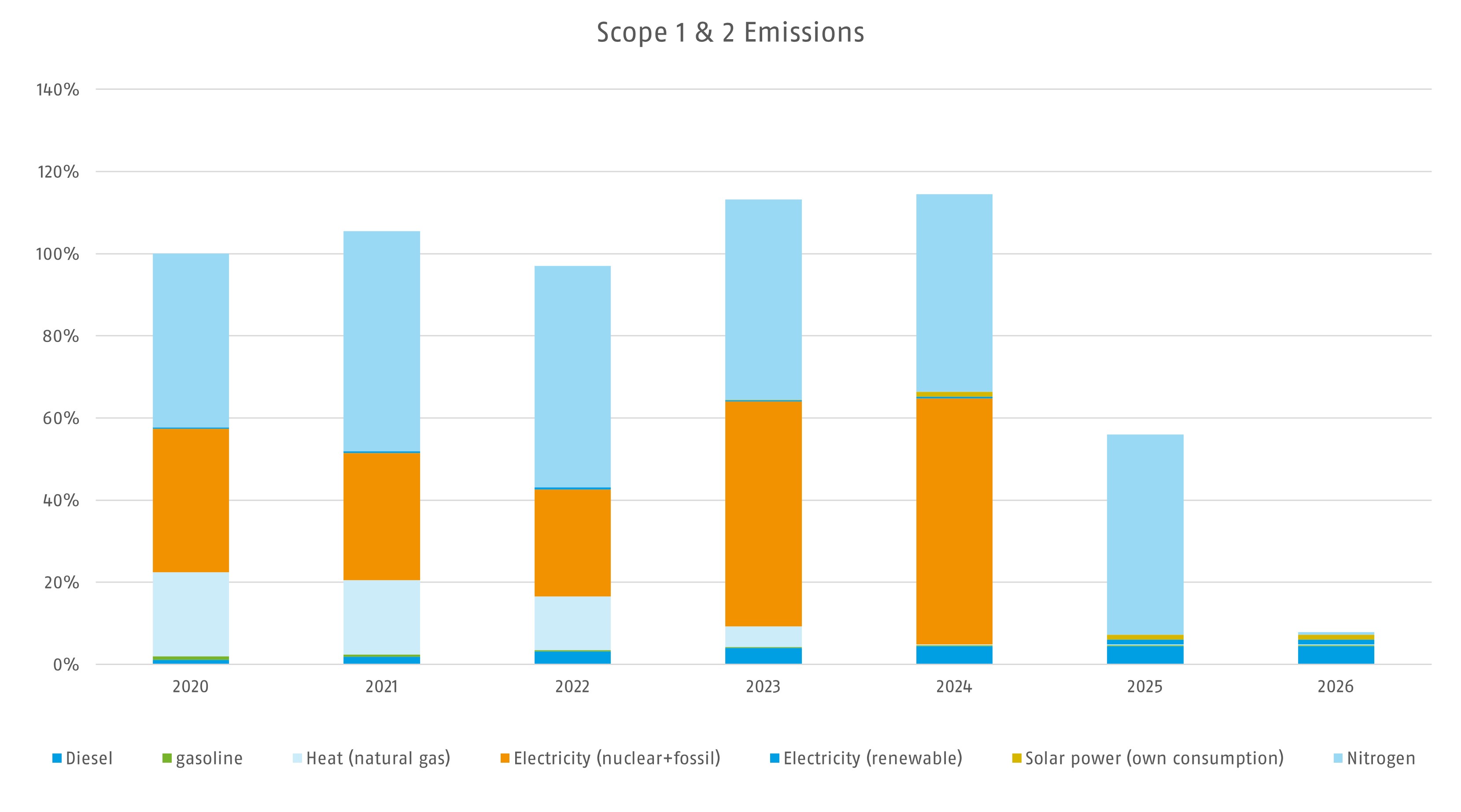
Scope 1 & 2 Emissions of Swissbit Production Site
Measures and effects of our environmental program on our Scope 1 and 2 emissions of Swissbit production site in Berlin, Germany:
2023:
Electrification for heating
2024:
Rooftop PV system
2025:
Green electricity
2026:
Transfer to green nitrogen
Supply Chain Transparency

Traditional supply chain management focused on cost, quality, and delivery. Today's requirements extend to environmental impact, labor conditions, business ethics, and security practices throughout the supplier network.
Swissbit uses the IntegrityNext platform to systematically monitor supplier ESG (environmental, social and governance) performance, enabling continuous assessment of environmental certifications, labor practices, anti-corruption measures, and information security across our supplier base.
We're working with key suppliers to address upstream emissions and identify reduction opportunities throughout our value chain. While we can't control suppliers' practices, we influence them through procurement decisions and partnership development.
Our partnerships with European semiconductor suppliers reduce transportation distances and support regional economic development. We've secured additional semiconductor suppliers and established strategic partnerships, particularly with a new European partner, to strengthen supply chain resilience and reduce single-vendor dependencies.
CSR evolution on material topics
Supply chain management
Swissbit has continued to strengthen the resilience and sustainability of its supply chain. The integration of the IntegrityNext platform enable systematic monitoring of suppliers’ ESG compliance. To mitigate key risks – including dependency on far east suppliers, geopolitical pressures and upstream emissions – Swissbit has secured two additional semiconductor suppliers and established strategic partnerships, particularly with a new European partner.
GHG emissions and climate transition
Swissbit is making measurable progress towards its commitment of reducing CO2 emissions by 50% by 2030 (vs. 2019 levels), underpinned by a comprehensive climate strategy. Key levers include a full transition to 100% renewable electricity in 2025, the deployment of high-efficiency heat pumps, and the adoption of green nitrogen in 2026 – all contributing to both environmental impact and operational efficiency.
Operational eco-efficiency
Swissbit continues to demonstrate a strong operational eco-efficiency maturity. At its Berlin site in Germany, the company achieves over 95% waste separation. Swissbit also adopts a forward-looking approach to PFAS – balancing regulatory compliance with product innovation – positioning itself to mitigate risks while capturing emerging opportunities.
Partner for Sustainable Technology
Whether you need ESG data for your sustainability reporting, documentation for supply chain compliance, or a supplier committed to measurable environmental and social performance, Swissbit provides the transparency and practices that support your sustainability objectives.