PCIe 5.0 vs. PCIe 4.0: High-Speed Interfaces Meet Industrial Reality

Much of the discussion in the computer technology field regarding high-speed interconnects has focused on the transition from PCIe 4.0 to PCIe 5.0, especially considering the growing popularity of next-generation CPUs and motherboards. First, I examine the theory and practice surrounding the performance advantages. Then, I address thermal limitations and explain why 4-channel NAND is still preferred in industrial environments. Finally, I present my conclusions.
Introduction
In recent years, the transition from PCIe 4.0 to PCIe 5.0 has dominated discussions around high-speed interconnects in computing, especially as next-generation CPUs and motherboards proliferate. PCIe 5.0 promises to double the theoretical bandwidth compared to PCIe 4.0—offering 32 GT/s per lane versus 16 GT/s per lane, and up to 128 GB/s bidirectional throughput on a full x16 link. This leap is undeniably impressive in benchmarks and selected workloads, but the real-world impact - especially in industrial applications - remains limited due to critical environmental factors, most notably heat.
Performance Benefits: Theory vs. Practice
Lab tests and synthetic benchmarks consistently show PCIe 5.0 outperforming PCIe 4.0, particularly for sequential read/write tasks in content creation or HPC workloads. PCIe 5.0 SSDs often deliver 50–70% faster performance in these scenarios, with additional latency improvements from protocol and error correction enhancements.
However, in industrial deployments, these advantages are often outweighed by thermal and integration challenges:
- Real-world industrial environments rarely allow for the cooling necessary to sustain PCIe 5.0 speeds.
- Higher performance often leads to increased thermal output, pushing systems toward thermal throttling.
- Advanced PCB routing and signal integrity demands raise complexity and cost.
- Power consumption often exceeds what legacy or battery-powered systems can support.
- Sustained high throughput is often unnecessary or unused in edge and automation applications.
Thermal Constraints in Industrial Environments
PCIe 5.0’s faster signaling introduces significantly more heat due to increased power draw and stricter signal integrity requirements. Industrial deployments typically lack the thermal headroom available in data centers, making performance throttling nearly inevitable.
Key thermal design challenges include:
- Steep insertion loss budgets requiring active equalization
- More stringent PCB and connector layout constraints
- Limited or no active airflow in compact industrial enclosures
- High ambient operating temperatures (>40°C)
- Space and power limits that rule out active cooling solutions
Under these constraints, many devices must reduce performance or derate their operation just to remain within safe temperature thresholds. In these cases, PCIe 5.0's theoretical speed advantage becomes moot. That’s why many industrial systems still favor PCIe 4.0, which offers a better balance of performance, power efficiency, and thermal stability.
NAND Channel Scaling: 4-Channel vs. 8-Channel Modules
A similar trade-off appears in NAND flash architecture. While 8-channel NAND designs theoretically double bandwidth and IOPS compared to 4-channel SSDs, the increase in complexity and heat output often leads to diminishing returns.
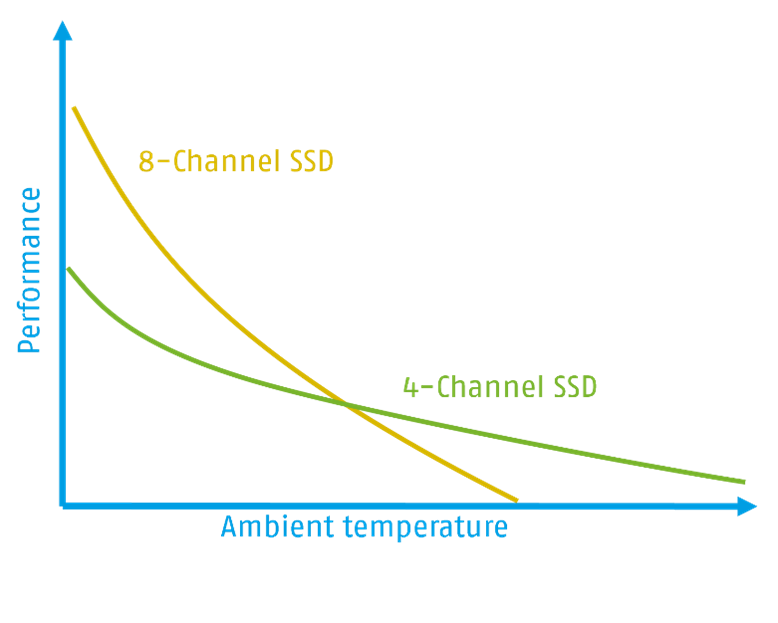
Why 4-channel NAND remains preferred in industrial settings:
- Less controller heat and reduced risk of thermal throttling
- Lower power draw fits tighter power budgets
- Better sustained performance in hot or unventilated environments
- Simplified thermal design with no need for heatsinks or fans
- Increased long-term reliability and fewer thermal-related failures
Unless advanced thermal mitigation is feasible, 4-channel modules provide a more practical, dependable solution for industrial use.
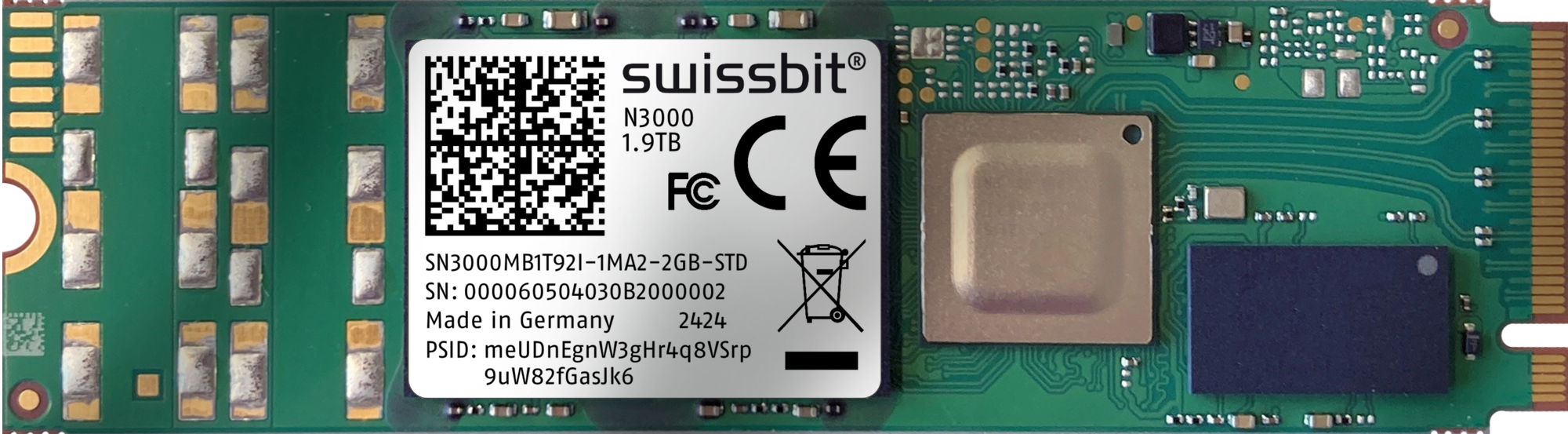
Swissbit N3000: Thermal-Efficient Storage for Rugged Deployments
The Swissbit N3000 Series PCIe Gen4, 4-channel SSDs are purpose-built for challenging industrial environments where airflow, power, and space are constrained. With a 4-channel design that generates less heat than 8-channel SSDs, the N3000 delivers consistent, throttling-free performance even in ambient temperatures above 40°C.
Its low power consumption makes it ideal for battery-powered or remote deployments, while integrated features like AES256 encryption, secure boot, power-fail protection, and remote management provide enterprise-grade security and data integrity. Available in compact M.2 form factors (2242/2280), it’s perfectly suited for rugged systems in edge computing, robotics, automation, and telecom applications.
Conclusion: Balancing Performance with Practicality
In industrial applications, thermal performance and system reliability often matter more than raw speed. While PCIe 5.0 and 8-channel NAND architectures showcase compelling performance gains in theory, their practical value is frequently negated by real-world limitations - especially heat. Industrial integrators must prioritize long-term dependability, MTBF, and ease of integration over peak bandwidth that may not be sustained outside of lab environments.
For these reasons, technologies like PCIe 4.0 paired with 4-channel NAND remain the logical choice for most rugged deployments. They offer a stable, proven balance of performance, thermal efficiency, and reliability. Until thermal and power design innovations catch up with the speed of interface standards, newer technologies will continue to face adoption hurdles in industrial use cases.
Überzeugen Sie sich selbst von unserer Kompetenz.

Martin ist Leiter des Produktmanagements & des technischen Marketings bei Swissbit Memory Solutions. Seine Leidenschaft gilt Produkten, Märkten und Kunden. Bevor er 2020 als Produktmarketing-Manager zu Swissbit kam, sammelte Martin mehrere Jahre lang in Großbritannien internationale Erfahrungen in den Bereichen Produktmanagement, Strategiemanagement und Konstruktionstechnik.